Sport Star - Team Manager Game
- 4.3
- Rating
- 500.00K
- Installs
- Free
- Price

 Analysis by App-foxy
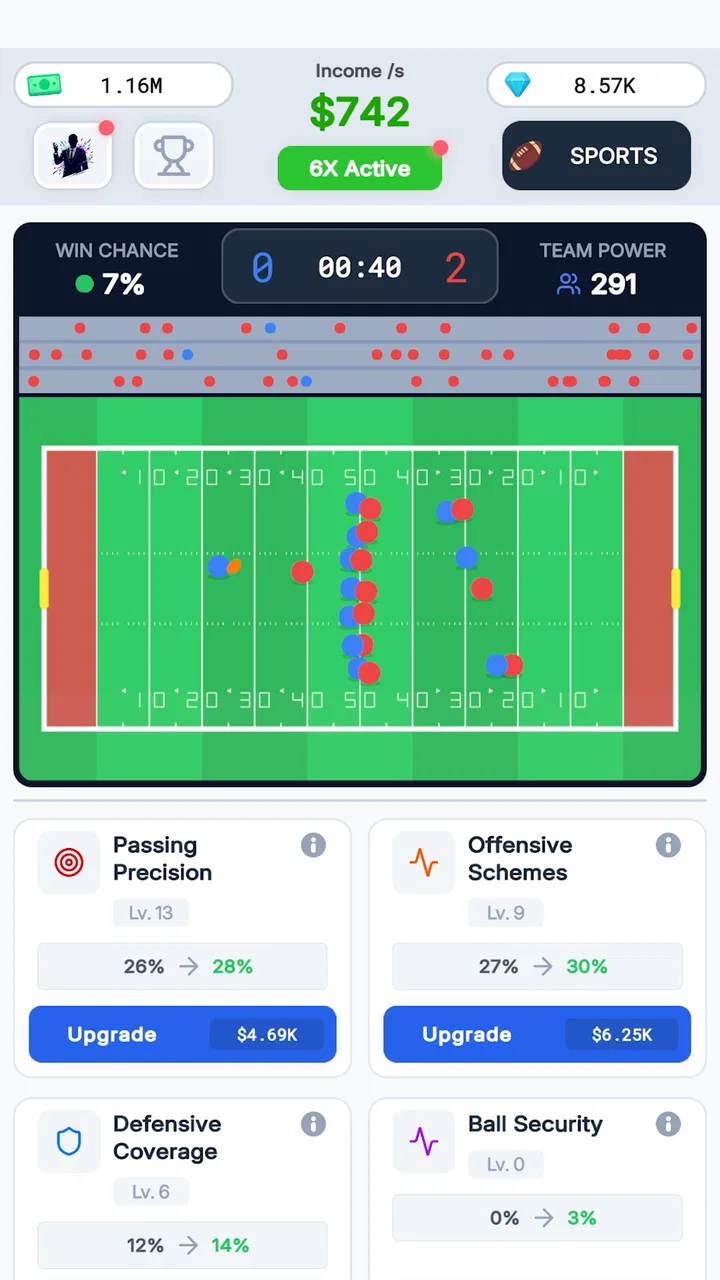
Sport Star - Team Manager Idle is the kind of sports game I open when I want progress without committing to a full match. Instead of controlling players directly, I build a team-oriented sports business and let the management side carry the experience. That makes it a lighter alternative to traditional sports titles, especially when I have a few spare minutes and want something that continues to feel purposeful between longer sessions.
Developed by Gryphon Games, the game is free to download and is rated for Everyone. Its store summary presents the central idea as building a sports team empire, while the shorter store label calls it Sport Star. Those descriptions are brief, but they point toward the real appeal: this is aimed at players who enjoy gradual growth, decisions about improvement, and the satisfaction of watching a small operation become more capable over time.
My overall impression is positive, with an important qualification. The game works best when I treat it as a relaxed management companion rather than a deep simulation or a substitute for a fully featured sports manager. It is easy to approach, but players who need detailed tactical control, realistic competition, or constant hands-on action may find the idle format too restrained.
You May Also Like

 Blood Strike: 2.5 Anniversary
Blood Strike’s Loadouts Turn Every Drop Into a Tactical Gamble
A close look at Blood Strike’s custom loadouts: how fast access to signature weapons reshapes its battle royale rhythm, rewards preparation, and narrows the gap between fights.

 Pandora - Music & Podcasts
Pandora’s Music Is Easy to Start, but Harder to Recover
Pandora’s strength is its low-effort path from a seed to a station. Its weak spot is how much confidence it asks you to place in connection, setup, and quiet recovery.

 8 Ball Pool
 Is Built on Rivalries, Rematches, and Routine
A close look at the rivalries, rematches, shared routines, and unanswered safety questions that turn a quick pool match into a persistent mobile community.

 Samsung Music
’s Quiet Strength Is Playing What You Already Own
Its reach comes less from spectacle than from dependable access to a personal library. That simplicity is both the app’s strongest retention engine and its ceiling.

 AccuWeather: Weather Radar
AccuWeather Review: A Quick, Clear Forecast for Everyday Decisions
For everyday plans, the best forecast is the one you can understand quickly. AccuWeather makes rain timing, radar, and local conditions easy to act on, with a few trade-offs.

 Hill Climb Racing
Why Hill Climb Racing Still Turns Crashes Into One More Run
A tiny car, a bumpy hill and one more upgrade: Hill Climb Racing keeps resurfacing because its simple chaos makes every near-miss feel personal.
More From Our News Desk



How Sport Star feels during short and long sessions
I find short visits work best when I treat each one as a checkpoint: notice what has changed, choose a clear next step, and leave once that decision is made. Longer sessions can be useful for comparing priorities, but they also make the idle pacing more noticeable. That difference matters when deciding whether to keep playing now or let the next return bring a fresh reason to act.
Quick progress without demanding constant attention
The first thing I notice with an idle sports manager is how quickly I can understand its basic rhythm. I do not need to learn complicated controls before making progress. The experience is built around checking the team, deciding where to direct attention, and returning later to see what has changed. That makes it a natural fit for a commute, a short break, or the few minutes before going to sleep.
Its perceived speed is less about rapid animation and more about how quickly a session gives me a useful decision. A good idle game should not make every visit feel like opening a spreadsheet, and this one is most enjoyable when the next improvement is obvious enough to act on without a long preparation phase. I can make a small adjustment, collect progress, and leave with the sense that the visit mattered.
That convenience also creates the first trade-off. Because the game is designed around gradual development, it is not constantly throwing dramatic events at me. If I am looking for the immediate excitement of a basketball, football, racing, or arcade game, I would choose a direct-action title instead. Here, the reward comes from accumulation and planning rather than reflexes.
I also appreciate that the idle structure gives the game a different kind of accessibility. Someone who does not know every rule or strategy in a real-world sport can still understand the basic pleasure of improving a team. The focus is not on memorizing complicated plays. It is on recognizing that progress should be directed carefully instead of spent automatically.
What happens when I return after being away
A practical question for any idle game is whether coming back after a gap feels rewarding or confusing. Sport Star is most useful when I establish a simple routine: check what accumulated, make one or two deliberate improvements, and then stop before I start spending resources without a reason. That habit keeps the game from turning into a repetitive tapping exercise.
One of my more useful approaches is to avoid treating every available upgrade as equally urgent. I first look for the improvement that removes the biggest current bottleneck, then leave the rest for a later visit. This is a small distinction, but it matters in management games. Spending everything immediately can make the next session feel slower, while saving a little flexibility lets me respond to a new requirement or a more attractive improvement.
For an everyday example, I can imagine opening the game during a lunch break, collecting the progress that built up, and choosing one team improvement before returning to work. Later, I can check again without needing to remember a complicated chain of actions. That is where the idle design makes sense: it fits around the day instead of asking the day to fit around it.
Where heavier use changes the experience
Longer sessions reveal both the strength and the limitation of this format. At first, each visit feels productive because there are clear improvements to pursue. After more concentrated play, however, the pace can feel less energetic than a conventional sports game. The same low-attention design that makes short sessions comfortable can make extended sessions feel like waiting for the next meaningful decision.
I would not judge that as a flaw on its own. It is a question of expectation. Players who enjoy incremental management can settle into the slower cadence, while players who want a continuous stream of matches may feel that the game is asking them to be patient when they would rather be active. The best use is probably repeated short visits, not an uninterrupted evening of play.
Heavy use also makes resource discipline more important. When I am playing casually, an inefficient choice is easy to recover from because I can simply return later. When I am checking the game repeatedly, I am more tempted to make quick decisions just to keep the screen moving. My advice is to pause before each meaningful purchase and ask whether it improves the current team direction or merely creates the appearance of activity.
Stability and the practical side of reliability
For an idle title, reliability is not only about avoiding crashes. It is also about whether progress feels dependable when I leave and return. The game’s value comes from gradual accumulation, so anything that makes me uncertain about the state of my team weakens the central loop. I therefore pay attention to whether the return visit feels clear: what changed, what can be improved, and what decision should come next.
My experience is best when I keep expectations realistic. I do not treat the game as a demanding competitive service that must be watched continuously. I use it as a lightweight management game, and that makes occasional pauses less disruptive to the overall experience. The design is naturally more forgiving than a game where a missed moment directly changes the result of a match.
That said, idle games can create their own form of friction. If I leave the game for too long, I may return with several possible actions and no immediate sense of priority. The solution is simple but useful: choose a clear objective before closing the app. For example, I might decide that the next visit is for improving the team’s weakest area rather than spending everything available. This turns the next opening into a continuation instead of a fresh puzzle.
The game is also more comfortable when I avoid bouncing between too many decisions at once. A focused routine helps me notice whether progress is genuinely improving the team or whether I am just collecting and spending in a loop. That is an important reliability insight for this genre: a stable experience still needs a stable personal workflow.
Device requirements and what they mean in practice
Sport Star requires Android 12 or later, so it is not aimed at every older phone or tablet. That requirement should be the first thing to check before downloading, particularly if the device is several years old or has been kept on an earlier operating system. Players on compatible hardware should have a straightforward starting point, but the operating-system requirement does narrow the audience.
The game is free, which makes trying it easy, but optional purchases range from $0.99 to $109.99 per item. I would keep that range in mind before getting invested in the progression loop. A free entry point is useful, yet the presence of high-priced individual items means I would not hand the game to a child without checking purchase controls first, even though the content rating is Everyone.
That combination creates a practical device-and-household consideration rather than a gameplay complaint. The age rating describes the content, not the spending habits of every player. If I am setting the game up for a younger user, I would make sure purchases require an intentional confirmation process. For my own use, I would decide in advance whether I am playing entirely for free, because that removes pressure from later decisions.
As for resource demands, I prefer not to assume that a compatible operating system guarantees identical behavior on every device. Older hardware that can run Android 12 may still feel different from a newer phone, especially during longer play sessions or when other apps are active. The sensible approach is to keep the first session short, observe how the device handles it, and avoid judging the game solely by how it behaves under a crowded background workload.
How it compares with traditional sports games
The clearest comparison is with direct-control sports games. Those titles give me immediate movement, timing, and match-to-match tension. Sport Star gives me a slower management loop, where the satisfaction comes from building capability rather than personally executing every play. Neither approach is automatically better; they serve different moods.
Compared with a detailed sports management simulator, this game is easier to enter and less intimidating. I do not need to spend a long time learning a complex system before I can enjoy progress. The trade-off is depth. A player who wants extensive tactical layers, realistic league administration, or precise control over every part of a club should look toward a specialist manager instead.
It also differs from a purely casual sports mini-game. A mini-game can provide a quick burst of action and then end. Sport Star is more about the relationship between visits. I return because I want to see how the team has developed and decide what should happen next. That makes it more suitable for people who enjoy continuity, but less suitable for someone who wants every session to stand alone.
Three habits that make the progression feel better
The first habit is to set a development priority before spending. Rather than purchasing whatever becomes available, I choose the area that most clearly supports the team’s current stage. This prevents the common idle-game problem of making several small purchases that look satisfying but do not noticeably improve the overall direction.
The second is to separate collection from decision-making. I can open the game, gather what has accumulated, and wait a moment before choosing an upgrade. That short pause is valuable because it stops the reward animation or newly available option from dictating my next move. In a game built around incremental gains, patience is a genuine strategy.
The third is to use short sessions as checkpoints rather than trying to force constant activity. After making a meaningful improvement, I close the game and let the next visit provide a fresh reason to return. This approach reduces the feeling that I am staring at a progress bar and makes the idle structure work in my favor.
These habits are not complicated, but they reveal the game’s strongest hidden quality: it rewards restraint more than frantic interaction. The player who keeps a plan will probably enjoy it more than the player who taps through every available option simply because it is available.
Who will enjoy it, and who should skip it
I would recommend Sport Star to players who like sports themes but do not always have time for a full match. It is also a good match for people who enjoy gradual improvement, light management decisions, and a game that can be visited in small pieces. The Everyone rating makes it approachable from a content perspective, while the straightforward premise keeps the barrier to entry low.
I would be more cautious recommending it to someone who wants competitive action, realistic simulation, or a large amount of control over individual athletes. The idle format is the central identity, not a minor feature. If waiting between decisions sounds frustrating, the game will probably feel slow rather than relaxing.
I would also skip it if I am specifically looking for a completely purchase-free experience and I find broad in-app price ranges distracting. The game can be approached as a free title, but the available items mean that spending boundaries are worth deciding before play. That is especially relevant when the device is shared with children or when I tend to make impulse purchases during progression games.
What the current release tells me
The current version is 0.9.0, which suggests I should approach the experience with some patience. A version number like this can indicate a game that is still being shaped, so I would pay attention to how comfortable I am with the present loop rather than assuming it already has the breadth of a long-established sports manager.
That perspective also affects my expectations around polish and content variety. I would rather evaluate whether the central team-building routine is enjoyable now than buy into promises about what the game might become. For me, the current test is straightforward: do the decisions feel meaningful enough to make returning worthwhile, and does the pace remain pleasant after the initial novelty fades?
The game has attracted over 500 thousand installs, with an average rating of 4.3 from around 4.4 thousand ratings and 264 written reviews. Those figures show that it has found a real audience, but they do not replace personal fit. An idle sports manager can be well received and still be the wrong choice for someone who wants direct control or a more demanding simulation.
My performance verdict
Sport Star - Team Manager Idle feels most convincing as a low-pressure sports management game for short, repeated sessions. Its perceived speed is comfortable when I want gradual progress, and its resource demands are best considered in relation to the device rather than assumed from the genre. The Android 12 requirement is clear, and the free entry point makes it easy to test on compatible hardware.
The main limitation is also the main design choice: the game does not try to replace an action sports title. Its rewards arrive through development and return visits, so longer sessions can lose momentum if I need constant interaction. The wide range of optional purchase prices is another reason to set boundaries early, particularly for shared devices.
After using it, I see a game that suits a specific but sizable mood: I want sports progress, but I do not want to manage a full match or learn a complicated simulator. When I play with a clear upgrade plan and let the idle rhythm breathe, the experience is pleasant and easy to fit into daily life. My recommendation is to try it if steady team growth sounds more appealing than fast match action, while choosing a different sports game if hands-on control, deep tactics, or nonstop excitement matters most.
Gryphon Games has built an accessible starting point for this style of sports game. It is not the choice I would make for a serious simulation night, but it is a sensible companion for spare moments, especially when I want the small satisfaction of returning to a team that has moved forward since my last visit.
FAQs for Sport Star - Team Manager Game
01What is Sport Star - Team Manager Idle about?
Sport Star - Team Manager Idle is a simulation game that puts you in the role of a sports team manager. You are responsible for building and managing a team, making strategic decisions, and leading your team to victory in various tournaments. The game involves player recruitment, training, and upgrading facilities to ensure success on and off the field.
02Is an internet connection required to play Sport Star - Team Manager Idle?
Sport Star - Team Manager Idle can be played offline, allowing you to manage your team without an internet connection. However, some features, like competitive leaderboards, social interactions, and special events, require online access to enhance the gaming experience and connect with other players.
03What platforms is Sport Star - Team Manager Idle available on?
Sport Star - Team Manager Idle is available for both Android and iOS devices. You can download the game from the Google Play Store for Android or the Apple App Store for iOS. It is designed to be compatible with most smartphones and tablets, allowing you to manage your team on the go.
04Are there in-app purchases in Sport Star - Team Manager Idle?
Yes, Sport Star - Team Manager Idle offers in-app purchases. While the game is free to download and play, players can purchase in-game currency and special items to speed up progress or enhance their team. These purchases are optional, and the game can be enjoyed without spending real money.
05How does player recruitment work in Sport Star - Team Manager Idle?
In Sport Star - Team Manager Idle, player recruitment is a crucial element of gameplay. You can scout and recruit new players from various regions, each with unique skills and potential. Balancing your team with a mix of talents and strengths is key to climbing the ranks and achieving success in competitions.
Pros
- Engaging team management mechanics.
- Intuitive user interface design.
- Regular updates with new features.
- Offline play available for convenience.
- Detailed tutorials for beginners.
Cons
- In-app purchases can be pricey.
- Occasional bugs in newer updates.
- Requires frequent internet connection.
- Limited customization options.
- Ads can be intrusive at times.

Sport Star - Team Manager Game
Gallery